
Understanding and managing migraine holistically
Holistic is a word widely used in clinical practice. But what does it mean, and what is its importance in understanding and treating migraine? David Kernick, an Exeter based General Practitioner with an Extended role in Headache explores these questions and their implications in the first of a two part blog.
Modern medicine identifies specific biological processes involved in disease and develops treatments to target them. A holistic approach (holistic is derived from the Greek word Holos, which means whole) steps back and takes a broader view, focusing on the interconnection within and between the body and the outside world rather than seeing migraine as a strictly neurological problem. The focus shifts from seeing the body as a machine and identifying the part that needs fixing to an appreciation of the complex interaction between brain, body, and environment. This approach complements the medical model and aims to mobilise the body’s intrinsic ability to heal itself.
For someone who has occasional migraine, medication alone may be all that is needed. However, as migraine becomes more frequent or begins to affect daily life, taking a broader view becomes helpful.
This blog is in two parts. The first part deals with how a holistic approach would understand migraine. The second explores implications for migraine management.
What would a holistic approach to understanding migraine look like?
One broader holistic approach to understanding migraine that is supported by emerging evidence would comprise of three interacting elements.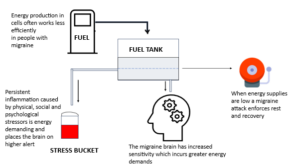
i). An energy demanding more sensitive brain
A useful starting point is to think about the brain’s energy demands. Although the brain accounts for only around two per cent of total body weight, it uses approximately 20 per cent of the body’s energy.
In people living with migraine, the brain is more sensitive to sensory information and environmental change. This heightened sensitivity is largely determined by genetics and means the brain works harder to process everyday experiences consuming more energy. From an evolutionary perspective, this increased alertness may once have offered important survival advantages. Being more sensitive to changes in the environment could have helped our ancestors detect danger more quickly. In today’s world of constant exposure to stimulation, it places additional energy demands on a brain that is already working harder than average.
When energy demands become too great, a migraine attack may develop. It may help to think of it as a protective response when the brain’s energy demands are not being met adequately, inducing a period of forced rest.
ii). Problems with energy production
Each cell in the body has its own energy generator found in a specific part of the cell called mitochondria. Research suggests that the mitochondria in people with migraine may be less efficient at generating energy adding to the energy problem.
iii). Problems with chronic or persistent inflammation
Inflammation is the body’s way of protecting itself after injury or infection, triggering complex defensive and repair mechanisms. However, this system can be activated by a wide range of stressors that would not have been experienced when the inflammatory mechanisms were developed during our early evolution (see Figure 2).
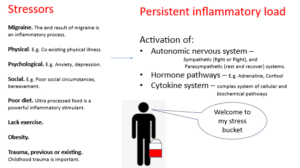
Inflammation can build up over time due to ongoing stressors and is held across the brain and body (“the body keeps the score”). For example, increased heart rate, blood pressure, breathing rate, muscle tension. This unnecessary activity not only consumes energy but is interpreted by the brain as signs of danger, increasing further its state of vigilance and making future migrant attacks more likely. This is the road to chronic migraine.
Having mapped out a holistic picture of migraine, we can now consider a broader range of approaches to address this.