
What actually happens in the brain during a migraine attack?
In the second of a series of blogs, PhD researcher Mignon Van der Watt shares with us what is understood to be happening inside the brain during a migraine attack.
A simple guide to the phases of a migraine attack and what researchers think is happening inside the brain.
Many people mistakenly believe a migraine attack to be “just a bad headache”. But inside the brain, a migraine attack is far more complex.
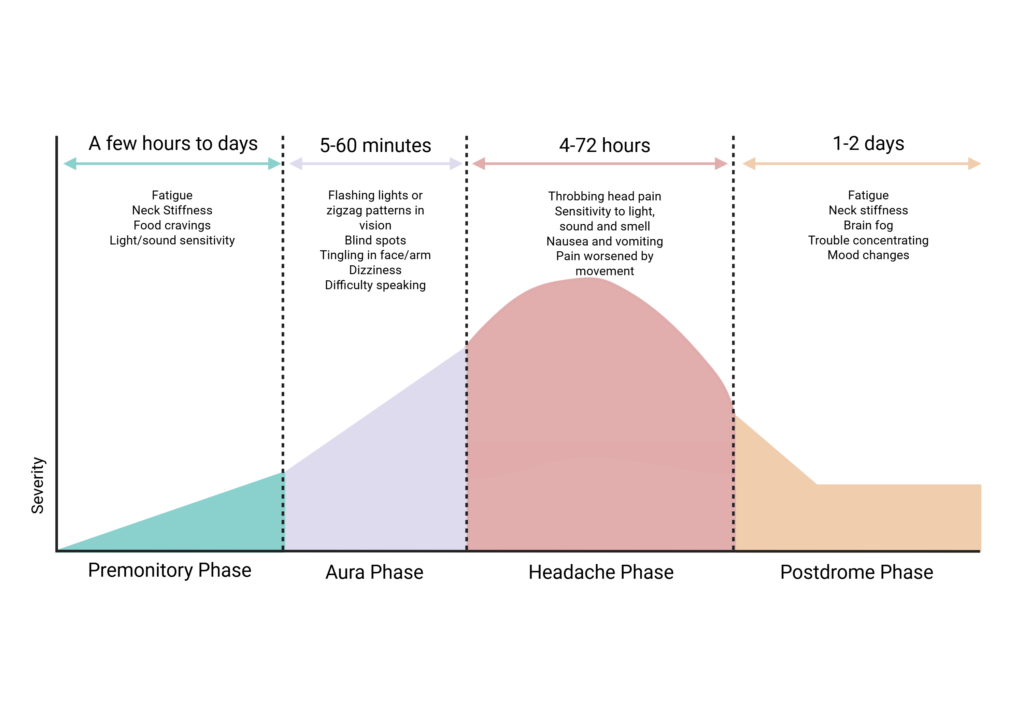
A migraine attack is a brain-wide event, meaning it involves changes in nerve activity, brain chemicals, blood vessels and sensory processing. These changes unfold over time and lead to four commonly defined phases of a migraine attack.
Researchers often divide these phases into:
- Prodrome or Premonitory phase
- Aura phase (only in approximately 30% of cases, defined as migraine with aura)
- Headache phase
- Postdrome phase
Let’s walk through what researchers currently think is happening inside of the brain as a migraine attack unfolds.
The premonitory phase: the brain’s early warning system
For many people, the first signs of a migraine attack, or premonitory symptoms, show up before the head pain even begins. These symptoms are indicators that the migraine attack, and its underlying changes in the brain, have already started.
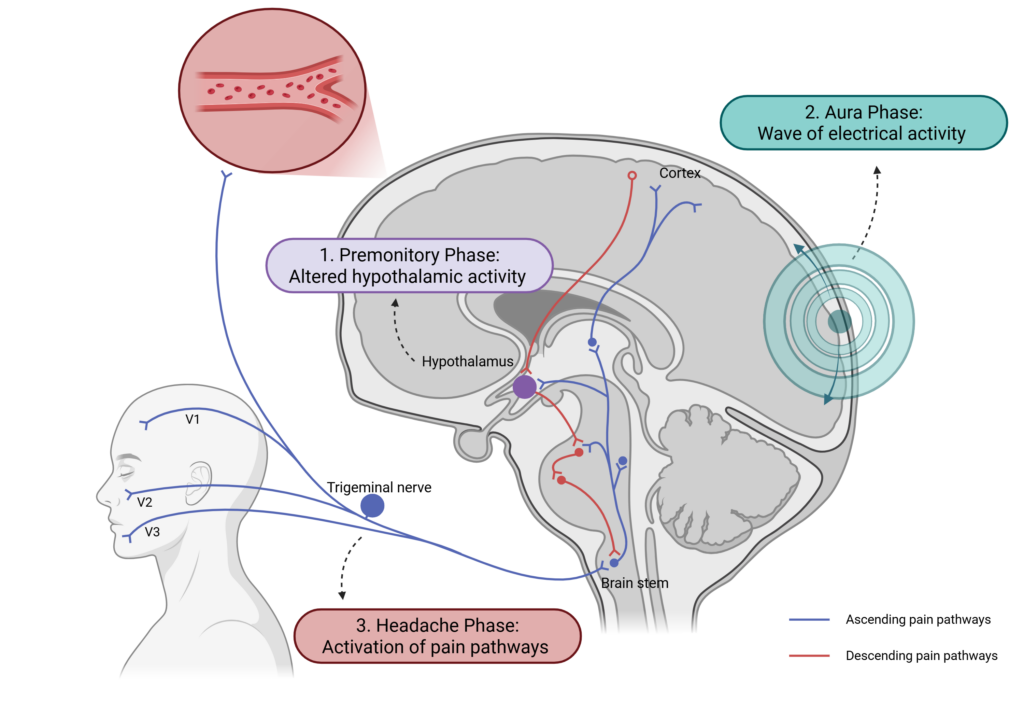
One of the brain regions that is believed to be important in generating premonitory symptoms is a small almond-sized region deep in the brain, called the hypothalamus. We know that the hypothalamus is activated in migraine, before the onset of head pain and its normal function is to keep the body in a stable, consistent state, adjusting to changes in the environment (a process known as homeostasis). In a way, it is like the master thermostat, monitoring internal and external conditions and regulating things like appetite, sleep, and hormones. Given this important function, changes in activity of the hypothalamus are thought to lead to some of the diverse non-pain symptoms that occur, including fatigue.
It’s still unclear exactly what triggers the cascade of changes that happen during a migraine attack. But a better understanding of the biology underlying the earliest premonitory phase may give us clues that hint at how migraine attacks begin, offering new hope for treatment.
Aura: a wave across the brain
Up to one third of people living with migraine experience aura as part of a migraine attack.
This phenomenon is called Cortical Spreading Depression (or CSD for short). This wave travels surprisingly slowly at only a few millimetres per minute. As it moves across different regions of the cortex, it interrupts normal brain activity, giving rise to the symptoms experienced, including visual symptoms when it crosses the visual cortex.
The headache phase: pain-pathways are activated and become sensitised
The phase that most people associate with migraine is the headache phase. During this time, there are several processes occurring simultaneously in the brain.
A key player in the headache phase is the trigeminal nerve. This nerve is responsible for carrying sensory information from the face and head to the brain. During a migraine attack, the trigeminal nerve becomes activated and sends pain signals to different areas of the brain. The nerve endings also release chemical signals, like Calcitonin Gene-Related Peptide (CGRP), which helps drive inflammation and increases sensitivity of pain pathways in the brain. As these pathways become more active, the brain begins to amplify sensory signals. This is why some people with migraine often become sensitive to light, sound and even smells. Overall, the brain’s pain-processing network is being switched into overdrive making it highly sensitised and overactive. Currently several therapies target this phase including molecules that block the actions of CGRP.
The Postdrome: the migraine “hangover”
Even after the headache fades, the migraine attack isn’t over.
People often describe the postdrome as feeling like a “migraine hangover.” At this point, the brain is gradually recovering from the migraine attack. Pain pathways sensitivity is reducing, but networks involved in things like attention, thinking, and energy regulation may still be temporarily affected.
Research investigating this phase is currently limited. In the future, research into this phase will hopefully provide a better idea about the changes happening in the brain at the end of a migraine attack.
The big picture
A migraine attack is a cascade of events occurring outside and inside the brain, not just a single event.
These events unfold in phases:
- Brain regulation changes begin in the premonitory phase
- A wave of altered electrical activity can spread across cortex during aura phase
- Pain pathway and sensory systems become active and sensitised during the headache phase
- The brain recovers during postdrome phase
Understanding migraine in light of all the changes that occur over time helps explain why it’s considered a neurovascular disorder, not simply a severe headache. Researchers are still working to fully understand how and why these attacks occur, hopefully leading to more answers to the question marks that remain to be answered about migraine biology.