
Finding migraine information online in the age of AI
If you’ve searched for migraine information online in the last few months, chances are you’ve encountered some AI-generated information (whether you realised it or not!)
Technological advances like AI can be a game changer in terms of how we access information. However, being aware of the potential pitfalls of migraine information derived from AI is essential.
What is AI and how does it work?
Lately, there has been a lot of discussion about the use of AI, but what exactly is it, and how can we make sure that the information we get from it is accurate?
AI stands for Artificial Intelligence and usually refers to machine learning. Machine learning is a process where lots of information from across the internet is analysed to help systems learn patterns, which can then predict outputs. This technology has improved a lot in the last few years, but there can still be no guarantee that the information it provides is correct, because it is based on predictions. ChatGPT, Claude AI, Google Gemini and Microsoft Copilot are popular generative AI applications that use this technology to generate new text or images, based on the prompt (a question or instruction) provided by the user.
As well as these separate applications, AI is now incorporated in many search engine tools, including Google which provides ‘AI summaries’. The information in these summaries is based on a combination of different webpages and is not necessarily always accurate or relevant. So, what can we do to ensure we aren’t being misinformed when using this technology?
Knowledge is power!
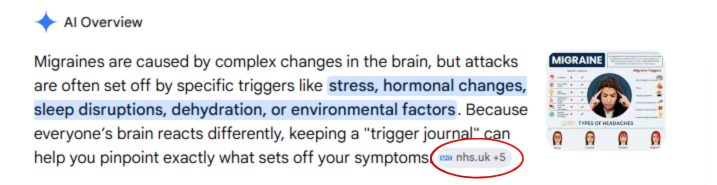
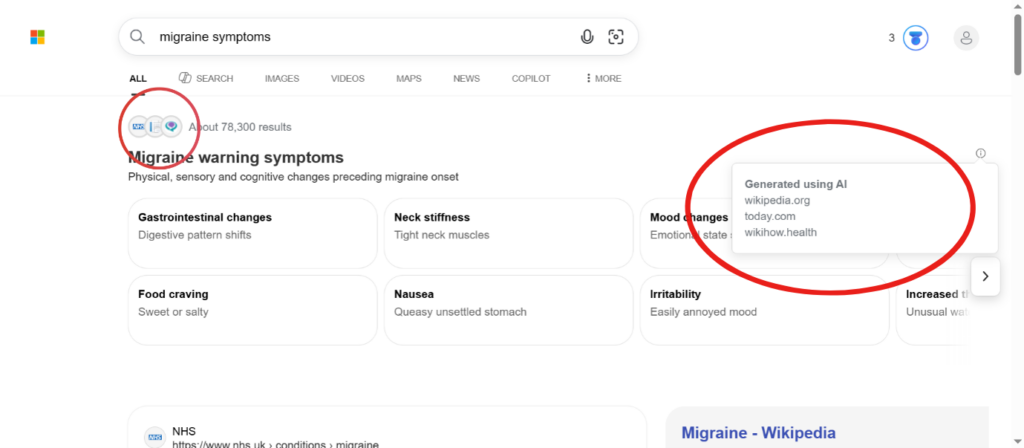
Knowing when and where AI is being used is helpful, as it isn’t always immediately obvious. Below are some examples of searches through and Google, using the search terms ‘migraine symptoms’ and ‘migraine triggers.’
Google: Logos of the sources used to generate the text are visible. Hovering over these symbols will give you more information and allow you to visit the source webpage.
For some search queries, such as the example below, you may be shown a ‘featured snippet’ either instead of, or along with, an AI summary. These featured snippets usually come from one source, rather than a summary from sources all across the internet.
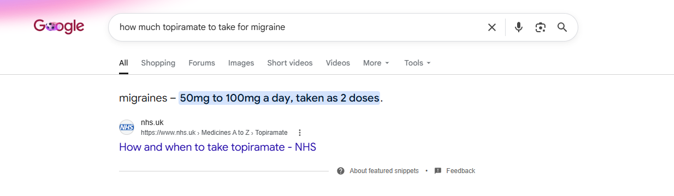
Figure 1 Example of a featured snippet
Microsoft Bing: Clicking the small ‘i’ symbol at the top right, you can see that the initial search results are generated by AI.
Why do sources matter?
AI collects information from sources all across the internet, which can be a great way to sift through lots of information very quickly. However, when it comes to migraine (and healthcare information generally) there are some potential issues with this approach:
- Some information may be less relevant to the UK: may pull information from sources across different countries, and not all of this will be relevant to people with migraine living in the UK. This can be a particular issue when it comes to availability of medications, and how to go about being prescribed them.
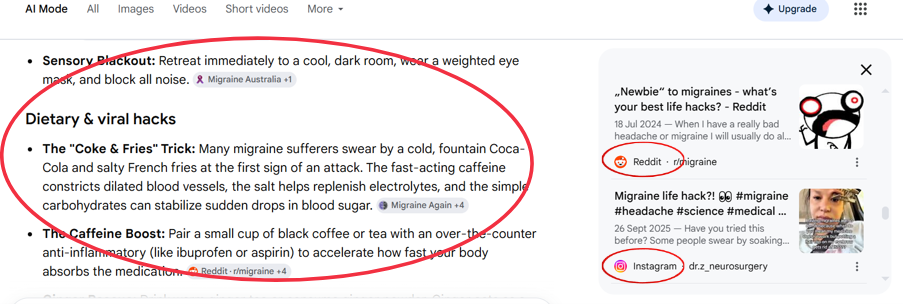
- Not all sources are equally reliable: Checking the sources from which AI has pulled information may show a mix of reputable healthcare sources (such as the NHS website, The Migraine Trust or other PIF TICK certified health charities) as well as sources like social media platforms. While discussions on social media sites, such as Reddit, can be helpful in showing us that we aren’t alone in our experiences, anecdotal information can be pulled through into AI summaries alongside accurate, evidence-based information. In the example below, some de-bunked migraine myths (such as the oft-repeated McDonald’s and Coca-Cola ‘hack’) are shown alongside well-documented approaches for reducing the impact of migraine symptoms. Exploring the sources that the AI summary has drawn from reveals several social media sites.
- Beware of sources that seem to be selling something: Some sources that AI summaries pull information from may actually be pushing paid-for Be mindful of information that mentions specific branded products.
When can AI be helpful when it comes to learning about migraine?
While there are some risks around navigating AI information for migraine (which we will set out in this blog), there are also lots of opportunities and ways that AI can prove very helpful. For example:
- Translations: AI can be a useful tool for translating information to or from different languages, which some people find helpful, especially if they are looking through information sources that aren’t in their native language.
- Medical terminology: AI can be used to explain what words or phrases mean. This can be particularly helpful when it comes to understanding medical terms you aren’t familiar with.
- General health advice: AI can provide helpful suggestions and resources when asked about more general lifestyle changes for health. For example, you could include details of a meal plan and ask, ‘how can I make my diet more balanced’?
- Finding trusted sources: AI can suggest trustworthy sources of information. For example, you could ask for a list of PIF TICK accredited websites on a topic that you can then find more information from.
Tips for using AI to find migraine information
AI can be a useful tool to find and condense information. Equipped with some knowledge on how best to use AI tools, you can feel more confident in navigating information online! Check out our top tips:
When using AI tools (like ChatGPT, Google Gemini, Microsoft Copilot, Claude AI)
Consider the wording of the prompts you use in searches: AI models are trained to please the user, and the language that you use in prompts can affect the response you receive. In the below example, using a symptom that isn’t associated with migraine, the AI search result essentially agrees with the user that chest pain is a rare symptom of migraine:
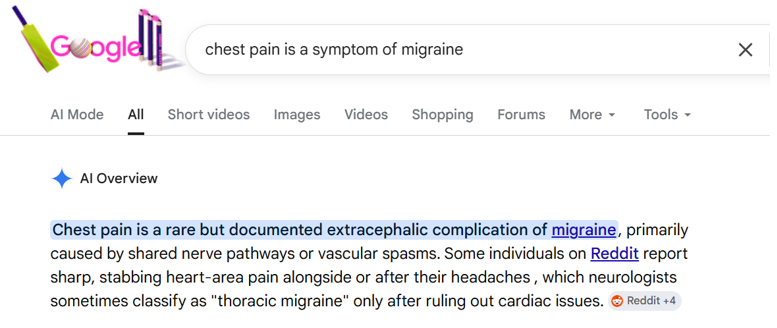
- Considering the phrasing you use in your search can help to ensure the information generated is more relevant to your needs. In the example above, using broader search terms such as ‘symptoms of migraine’ may help to reduce the likelihood of AI essentially agreeing with the user. In other situations, being more specific when searching for information can be helpful, for example searching for ‘migraine treatment options UK’ should avoid the information being pulled from sources in other countries which may not be as relevant.
When looking at results from an internet search engine that produces an AI summary
- Check out the original sources
As in the examples above, the sources that the AI summary has pulled information from should be visible. It’s often best to click through to the original source to better understand the context of the information and make sure you’re not missing anything.
- Avoid AI in Google search queries entirely by including ‘-AI’
If you’d rather avoid AI summaries in search results altogether, one tip is to add ‘-AI’ at the end of your search term. You can also navigate to the ‘more – web’ search option to bypass AI summaries in your search results.
- If in doubt, ask the experts!
Health is always a very personal situation – your experience of migraine and the treatment approaches that are suitable for you will most likely be different to another person living with migraine. That’s why it’s important to always check health advice with a healthcare professional who is aware of your unique situation.
For more general advice, The Migraine Trust’s information pages are reviewed by expert health professionals and people affected by migraine.
Our information has also been awarded the PIF TICK quality mark so you can be confident that it is trustworthy health information.
Our helpline team are also here to provide free, evidence-based information and support on all aspects of migraine, if you ever want to check that the information you have is accurate. Check out the ways you can get in touch.