
Migraine and sleep: a deep dive into the biological processes at play
In the latest of our blog series, PhD researchers Mignon Van der Watt and Veronica Munday explore the biological processes involved in migraine and sleep
Sleep is essential for our mental and physical health. We spend around a third of our lives asleep, so perhaps it’s not surprising that, for many people living with migraine, the time spent asleep can have a large influence on their attacks.
The relationship between sleep and migraine
The relationship between migraine and sleep is thought to go both ways: sleep can affect migraine, and migraine can affect sleep. An example of this is that sleep disruption is one of the most commonly reported migraine triggers. Sleep disruption can mean several things: a change in your regular sleep pattern (e.g. more or less sleep than usual) or waking up frequently throughout the night. The reasons for this relationship are not fully understood, however many of the brain regions associated with migraine also help control when we’re asleep and awake. Understanding what happens when we sleep, and how our sleep is regulated, can help to build good sleep routines and minimise the impact of sleep disruption on migraine.
More than just hours in bed: Sleep cycles across the night
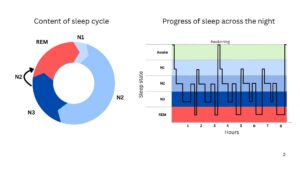
Just as there are different phases to the migraine attack, there are different phases to our sleep across the course of the night. Sleep can be divided into two types: non-rapid eye movement sleep (NREM) and rapid eye movement (REM) sleep. Our sleep occurs in cycles lasting around 90 to 120 minutes, with 4 to 6 cycles on average per night.
Each cycle begins with light sleep and becomes progressively deeper. First comes N1, a short, light phase of sleep which occurs as we first drift off. This is followed by N2, which is the most common phase – about half of our total sleep across the night. As our sleep continues, we sink into N3 sleep, known as slow-wave sleep, or deep sleep; this phase is thought to be the most restorative. After NREM, comes REM sleep. This is the part of sleep which is most often associated with dreaming.
As the night goes on, the amount of NREM and REM sleep in each of these cycles’ changes. Early in the night, the cycle is dominated by NREM, with short periods of REM towards the end. As we move through to the early hours of the morning the length of REM increase.
Good quality sleep doesn’t just mean aiming for 8 hours
Sleep disruption can impact specific stages in different ways. Frequently waking up may reduce the amount of restorative deep sleep you get, as each time you fall asleep you restart the cycle at light sleep. On the other hand, sleeping too little may mean you miss out on those all-important more restorative later sleep cycles. Too much sleep, such as a lie in, can have a knock-on effect for sleep the following day, confusing your normal sleep cycle and making it harder to fall asleep at your usual bedtime the next day.
The amount of sleep we need at night varies from person to person. Some of us may wake up feeling refreshed after only 7 hours, while others need much closer to 9. Research suggests that it is not the total amount of sleep each night which influences migraine, but a shift in your usual . Maintaining a consistent bedtime routine, even on days off, can be a good approach to help some people manage their migraine. But how does the body know when it’s time to go to bed?
Your body’s internal clock: the circadian rhythm and the role of melatonin
The time our body naturally wants to go to sleep is regulated by our circadian rhythm. This can be described as our internal body clock, coordinating the body’s processes over a roughly 24-hour cycle. This allows our body to anticipate regular changes in the environment and align our behaviour, such as when to sleep or to eat. Our internal clock is controlled by a small group of brain cells, in the suprachiasmatic nucleus, which is located in the hypothalamus. One of the most important signals which keeps our internal clock synchronised with the external world is light, adjusting to altered light exposure across the day.
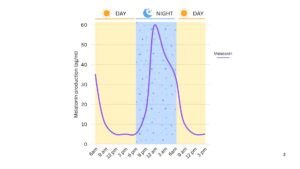
Our internal clock then talks to our body in several ways. One of the most important of which is via melatonin, a hormone which is released at night, helping us prepare for sleep. Levels peak in the middle of the night before gradually falling towards morning, signalling that it is time to wake up. As light inhibits melatonin release, artificial light, especially at night, can interfere with the process, making us less ready for sleep. This is why avoiding blue light from screens for at least 1 to 2 hours prior to bed is recommended.
Why your body clock matters for migraine
We all have a natural preference for when we feel most awake and when we prefer to sleep. Some of us, known as “morning larks”, prefer to rise early and feel most productive in the morning, while “night owls” prefer a later start and later evening. This preference is called your chronotype. Research suggests that people living with migraine are . However, work, school or social commitments do not always fit well with these preferences. When people are forced to follow a sleep-wake schedule that differs from their natural rhythm, they can experience what is known as . Like jetlag, where your biological clock is misaligned with your new time zone, social jetlag is where your biological clock is misaligned from your social schedule. This misalignment between the body clock and daily life may increase the likelihood of a migraine attack. So, understanding your natural sleep pattern may help you identify changes that could help with your migraine.
Interestingly, there is growing evidence that migraine itself may be influenced by the body’s internal clock. While migraine attacks can occur at any time of the day or night, many people report that their attacks occur at a particular time of day, for example, in the early morning. There is also some evidence that melatonin rhythms may be altered in some people with migraine. Consequently, there has been some interest as to whether taking melatonin may be beneficial in helping to treat migraine. Some of the evidence to date indicates that melatonin may help to reduce monthly headache days when used as a preventative, however further research is required to determine its efficacy in larger samples, and in comparison, to existing . As with any treatment approach for migraine, every medication has potential benefits, side effects or risk of interacting with other medications, so it’s important to speak to your GP about what is right for you when considering new treatments.
The complex link between sleep and migraine is slowly being unravelled, although it is clear that maintaining healthy sleep habits can form a valuable part of a broader migraine management plan.